Drug Addiction Relapse Rates: Understanding the Numbers
Drug addiction relapse rates affect 40–60% of people in recovery. Learn what the numbers really mean, what drives relapse, and how to prevent it.
Drug addiction relapse rates are one of the most misunderstood statistics in public health. When people hear that nearly half of all individuals in recovery return to substance use at some point, the immediate reaction is often despair or skepticism. Why pursue treatment if the odds seem stacked against you?
But those numbers tell a more nuanced story than they first appear to. Relapse is not a sign that treatment failed. It is a recognized, well-documented feature of a chronic disease — one that medical researchers compare directly to conditions like diabetes, hypertension, and asthma. In each of those illnesses, patients sometimes fall back into old patterns. That does not mean the treatment was worthless or that recovery is impossible.
What it does mean is that substance use disorder requires ongoing management, not a single cure. The data shows us where the highest-risk windows are, which substances carry the greatest danger of relapse, and what protective factors genuinely make a difference over time.
This article breaks down the core statistics on drug and alcohol relapse rates, explores the factors that drive them, examines how different substances compare, and outlines what evidence-based approaches actually work for relapse prevention. Whether you are in recovery yourself, supporting a loved one, or working in behavioral health, understanding these numbers is the first step toward using them constructively.
What Does Drug Addiction Relapse Actually Mean?
Before examining the numbers, it helps to define the term precisely. In everyday language, “relapse” tends to mean a complete return to heavy substance use. In clinical research, the definition is more layered.
Addiction relapse typically refers to a return to substance use after a period of abstinence. Researchers often distinguish between:
- A lapse — a single or brief return to use, sometimes called a “slip”
- A relapse — a sustained return to problematic patterns of use
- A prolapse — a complete return to pre-treatment levels of use
This distinction matters because studies measure these differently. When a study reports that “85% of people relapse within a year,” it is often capturing any return to use, including a single drink or a one-time episode. That figure tells a different story than saying 85% of people return to full-blown active addiction.


The American Psychiatric Association defines substance use disorders as the uncontrollable, continued use of drugs or alcohol despite negative consequences. Because addiction rewires the brain’s reward circuitry over time, recovery is rarely a straight line. Understanding the difference between a lapse and a full relapse is essential for both patients and clinicians designing relapse prevention programs.
Drug Addiction Relapse Rates: The Core Numbers
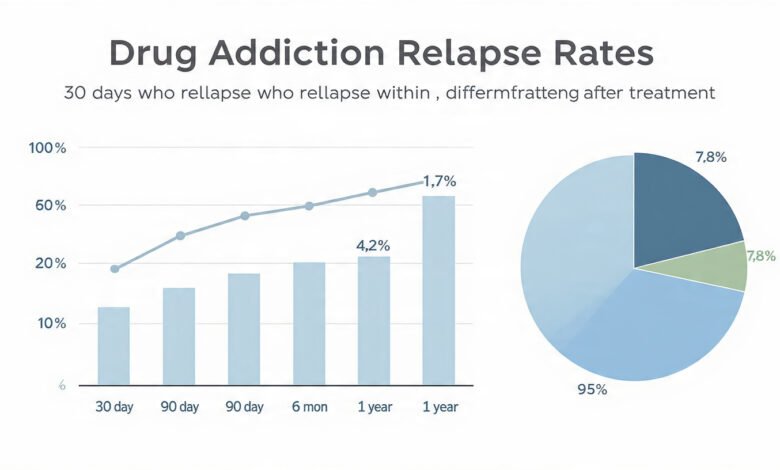
Drug addiction relapse rates are estimated to affect between 40 and 60 percent of individuals with a substance use disorder, according to the National Institute on Drug Abuse (NIDA). These figures are directly comparable to relapse rates seen in other chronic medical conditions such as diabetes and hypertension.
Here is what the research actually shows, broken down by timeframe:
Relapse in the First Weeks of Treatment
Two-thirds of individuals resume drug use within a few weeks of starting addiction treatment. This is one of the most striking statistics in the addiction literature and one that often goes underreported. The early weeks are the highest-risk window, when withdrawal symptoms are at their peak and coping skills are only beginning to develop.
Several studies have shown relapse rates as high as 65–70% in the 90-day period following treatment completion.
Relapse Within the First Year
Research suggests that the most significant period for relapse is within the first 6–12 months after treatment, with approximately 85% of relapses occurring during this time.
Studies indicate that approximately 40–60% of individuals relapse within 30 days of leaving an inpatient drug and alcohol treatment center, and up to 85% experience relapse within the first year.
Relapse Over the Long Term
While drug addiction relapse rates decrease after the initial twelve months, even after two years of recovery from substance abuse, there remains a 40% likelihood of drug relapse.
After 5 years of continuous sobriety, a person’s risk of relapse drops to less than 15%, similar to the general population.
The trajectory is encouraging. The further a person gets from their last use, the more the odds shift in their favor.
Relapse Rates by Substance
Not all substances carry the same relapse risk. The type of drug involved is one of the strongest predictors of whether and when someone returns to use.
Opioid Relapse Rates
Opioids are often considered the most addictive type of drug. A study in the Indian Journal of Psychological Medicine states that relapse rates for opioid addiction are as high as 91 percent.
Part of what makes opioid relapse so dangerous is the tolerance reset that happens during recovery. When a person becomes sober and experiences withdrawal, their body and tolerance levels react accordingly, pushing their tolerance closer to normal. When that person then relapses on opioids, they take the same increased amount they had before, and the body is not ready to process it. This is a leading cause of fatal overdose.
The widespread presence of fentanyl in the illicit drug supply has made this situation even more dangerous. Fentanyl is a synthetic opioid that is 80 to 100 times more powerful than morphine and is among the leading causes of overdose deaths in America.
Alcohol Relapse Rates
40–80% of patients undergoing treatment for alcohol use disorders experience a “lapse” within the first year post-treatment.
Research shows that alcohol and opioids have the highest rates of relapse, with some studies indicating a relapse rate for alcohol as high as 80 percent during the first year after treatment.
Around 20% of patients return to pre-treatment levels of alcohol use. That is an important distinction — a large portion of people who experience a lapse do not go all the way back to where they were before treatment.
Nicotine and Heroin Relapse Rates
Nicotine, heroin, and alcohol produce similar rates of relapse, ranging from 80–95% over a one-year period. This comparison is useful because it contextualizes addiction science. Nicotine is widely understood to be highly addictive, yet most people do not moralize about someone who struggles to quit smoking. The same scientific understanding should apply to all substances.
Stimulant Relapse Rates (Cocaine and Amphetamines)
Individuals using stimulants like cocaine and amphetamine face a 50% relapse rate within the first year. Stimulants do not produce the same physically dangerous withdrawal that opioids or alcohol do, but the psychological cravings can be intense and persistent, making cocaine and methamphetamine relapse particularly difficult to prevent without structured behavioral support.
Marijuana Relapse Rates
Rates for marijuana relapse are high as well. The journal Biological Psychiatry found that roughly 49% of participants who sought care for a marijuana addiction relapsed within the first day that marijuana was available after treatment. This speaks to the power of cue-triggered craving, even for substances that are often considered less addictive.
Key Risk Factors for Drug Addiction Relapse
Understanding the statistics is only useful if we also understand what drives them. Research has identified several reliable risk factors for substance abuse relapse.
Withdrawal Symptoms
The first week after stopping substance use is particularly critical, as many individuals relapse during this period to avoid withdrawal symptoms. Physical discomfort, anxiety, sleep disruption, and pain make the early days of abstinence genuinely difficult. Medical detox can help manage this phase, reducing the risk of early relapse.
Social Environment and Peer Influence
A 2024 study published in the Journal of Substance Abuse and Addiction Treatment established a positive correlation between substance use disorder relapse and family conflicts, friendships with individuals struggling with addiction, and having addicted close relatives.
The people a person spends time with after treatment have an enormous effect on outcomes. Recovery is much harder when the social environment has not changed.
Emotional Triggers and Stress
Triggers are situations, emotions, or experiences that can activate cravings and prompt a return to substance use. They often include stress, negative emotional states, social pressure, and exposure to drugs or alcohol.
Stress is one of the most consistent and powerful predictors of relapse across all substances. The brain under chronic stress is more likely to seek familiar chemical relief.
Co-Occurring Mental Health Conditions
According to the 2023 NSDUH, among the 48.7 million people with a substance use disorder, 55.8% (27.2 million people) also had a mental illness. This is known as a co-occurring disorder.
Dual diagnosis — addiction combined with depression, anxiety, PTSD, or other mental health conditions — significantly raises relapse risk when only one condition is treated. For recovery to be durable, both conditions need to be addressed at the same time.
Socioeconomic and Demographic Factors
A study indicates that individuals with opioid addiction were more likely to be single, unemployed, belong to a lower socioeconomic status, and have a criminal record — all factors that can potentially influence the likelihood of relapse.
Financial stress limits access to treatment, therapy, and stable housing — all of which are protective factors in recovery. Addressing social determinants of health is not secondary to addiction treatment; it is part of it.
Biological and Neurological Factors
Among biological predictors of relapse, endocrine measures such as cortisol levels, cortisol/ACTH ratio as a measure of adrenal sensitivity, and serum brain-derived neurotrophic factor (BDNF) were found to be predictive of future relapse risk.
The science is increasingly showing that some individuals carry greater biological vulnerability to relapse. This reinforces why addiction should be treated as a medical condition, not a character flaw.
Why Drug Addiction Relapse Rates Are Comparable to Chronic Disease
This comparison comes up often in addiction medicine, and it is worth spending time on. According to the National Institute of Drug Abuse, “Relapse rates for addiction resemble those of other chronic diseases such as diabetes, hypertension, and asthma.”
This framing matters for a few reasons:
- It removes the moral stigma from relapse. A diabetic who eats poorly and sees their blood sugar spike is not a moral failure — they are a person managing a difficult, lifelong condition.
- It sets realistic expectations. No one expects diabetes to be permanently cured after a 30-day intervention. Why would we expect that of a complex brain disease?
- It justifies ongoing care. Chronic diseases require continuous management. The same is true of substance use disorder.
The disease model of addiction, now widely accepted in medicine, holds that addiction involves measurable structural and functional changes in the brain — particularly in areas governing impulse control, decision-making, and reward. Those changes do not reverse overnight. This is why relapse risk remains even after years of sobriety, though it does decline substantially over time.
Stages of Relapse: What to Watch For
Relapse is rarely a single moment. It typically unfolds in stages, and recognizing these stages early gives people in recovery and their support networks a better chance of intervening.
Emotional Relapse
This is the earliest stage and happens well before any substance use. Signs include:
- Isolating from others
- Skipping therapy or support group meetings
- Poor sleep and self-care
- Bottling up emotions rather than processing them
At this stage, the person is not consciously thinking about using. But their emotional state is creating the conditions for relapse.
Mental Relapse
In this stage, the internal debate begins. Signs include:
- Romanticizing past drug or alcohol use
- Planning or fantasizing about using “just once”
- Spending time with people who still use
- Minimizing the consequences of past use
Mental relapse is the most dangerous stage because it looks invisible from the outside.
Physical Relapse
This is the actual return to substance use. Even at this stage, many people can interrupt the cycle before a lapse becomes a full relapse — if they have the support and tools to do so.
Evidence-Based Approaches to Relapse Prevention
The good news embedded in all of these statistics is that relapse prevention is not guesswork. A substantial body of research points to interventions that genuinely work.
Cognitive-Behavioral Therapy (CBT)
Relapse prevention (RP) is a cognitive-behavioral approach with the goal of identifying and addressing high-risk situations for relapse and assisting individuals in maintaining desired behavioral changes. RP has two specific aims: to help individuals who have already made a behavioral change maintain that change, and to help individuals still in the process of changing achieve and sustain it.
CBT teaches people to identify their personal triggers, challenge distorted thinking patterns, and build practical coping skills before high-risk situations arise.
Medication-Assisted Treatment (MAT)
Medication is one of the most effective tools available for reducing relapse rates in certain populations.
- Naltrexone is effective for both alcohol use disorder and opioid use disorder, blocking the pleasurable effects of these substances.
- Methadone and buprenorphine are used in opioid use disorder to reduce cravings and prevent withdrawal.
- Disulfiram is used in alcohol use disorder, creating unpleasant physical reactions to alcohol consumption.
- Varenicline and nicotine replacement therapies are used for nicotine dependence.
These medications do not eliminate the psychological dimensions of recovery, but combined with behavioral therapy, they substantially reduce relapse rates.
Peer Support and Recovery Communities
Long-term involvement in peer support structures — 12-step programs, SMART Recovery, sober living communities — is consistently associated with better outcomes. The social accountability, shared experience, and practical guidance from people who have navigated recovery themselves are factors that formal treatment alone often cannot provide.
Aftercare and Continuing Care Planning
It is important to approach relapse with empathy, support, and a commitment to ongoing care. One of the biggest structural gaps in addiction treatment is the drop in support that happens when a person leaves inpatient or residential care. Effective aftercare planning — including outpatient therapy, support groups, and check-ins with a treatment team — extends the protective benefits of formal treatment into real-world life.
Environmental Change
For many people, returning to the same environment, social circle, and routines that surrounded their drug use is the single biggest risk factor. Stable housing, changed peer networks, and structured daily routines have strong evidence behind them as protective factors.
Recovery is More Common Than the Relapse Numbers Suggest
It would be a disservice to leave the statistics at relapse without acknowledging what they do not capture: the enormous scale of recovery.
According to a landmark 2024 report from the Recovery Research Institute, an estimated 29.3 million U.S. adults (11.1%) report having resolved a significant substance use problem and are currently living in recovery.
According to the 2023 National Survey on Drug Use and Health (NSDUH), of the 48.7 million people with a past-year substance use disorder, nearly half (46%), or 22.4 million people, considered themselves to be in recovery or to have recovered.
Those are not small numbers. Recovery at scale is happening across the country, quietly, outside the frame of crisis coverage.
Those who do relapse still have the resources, support systems, and coping tools from treatment that will allow them to enter into recovery whenever they feel ready. A relapse is not the end of the story. For many people, it becomes a turning point that leads to more durable and informed recovery on the other side.
What the Numbers Mean for Policy and Treatment
The drug addiction relapse statistics reviewed here have direct implications for how we design and fund treatment systems.
Treatment duration matters. Short-term interventions — even high-quality ones — are not sufficient for a chronic condition. The evidence consistently shows that longer treatment engagement is associated with better outcomes. A 28-day program can be a valuable starting point, but it is not a complete solution.
Integrated mental health treatment is not optional. With over half of people with a substance use disorder also carrying a mental health diagnosis, treating only one condition is a recipe for relapse. Funding and access for co-occurring disorder treatment need to expand.
Access remains a critical barrier. Of the millions of people with a substance use disorder, the 2023 NSDUH found that a staggering 91.2% did not receive any treatment. Before relapse prevention can be addressed at scale, treatment access itself has to improve.
For authoritative data and up-to-date treatment guidance, the National Institute on Drug Abuse (NIDA) and SAMHSA’s National Helpline are two of the most reliable resources available.
Frequently Asked Questions About Drug Addiction Relapse Rates
What percentage of drug addicts relapse?
According to NIDA, relapse rates for substance use disorders range from 40% to 60% at any point during recovery. The risk is highest during the first six months after treatment, with approximately 40–60% of individuals experiencing a relapse during this window.
What drug has the highest relapse rate?
Opioids are associated with the highest relapse rates, with some studies placing the figure as high as 91% over the course of treatment and recovery. Nicotine and heroin have similarly high rates in the 80–95% range.
Does relapse mean treatment failed?
No. Relapse is a recognized feature of a chronic disease, not evidence that treatment did not work. A return to drug use after treatment completely misses the mark if seen as a failure — those who do relapse still have the resources and coping tools from treatment that will allow them to enter recovery again whenever they feel ready.
How long does relapse risk last?
After five years of recovery, the relapse rate drops to around 15%. The risk never reaches absolute zero, but it decreases substantially and steadily the longer a person remains in recovery.
Conclusion
Drug addiction relapse rates — ranging from 40 to 85 percent depending on the substance and timeframe measured — are not a reason to write off recovery as a realistic goal. They are a data-driven argument for treating addiction as the complex, chronic medical condition it actually is. The numbers show us where the highest-risk periods fall (the first weeks and months after treatment), which substances carry the greatest danger (opioids, alcohol, nicotine), and what drives relapse when it happens (withdrawal, stress, social environment, co-occurring mental health conditions).
They also show us a clear positive trend: the longer someone stays in recovery, the lower their risk becomes, with relapse probability dropping to roughly 15% after five years of continuous sobriety. With evidence-based treatments like cognitive-behavioral therapy, medication-assisted treatment, peer support networks, and robust aftercare planning, these numbers can and do improve. The goal is not to be discouraged by the statistics but to use them as a map — one that points clearly toward where support is most needed and when it matters most.