SMART Recovery Meetings: What to Expect
Nervous about your first SMART Recovery meetings? Here's exactly what to expect, from check-ins to the 4-Point Program, explained simply.

Walking into your first support group meeting is intimidating no matter what the group is called. If you’ve been searching for SMART Recovery meetings and wondering what actually happens once you sit down (or log on), you’re not alone. Thousands of people type some version of “what happens at a SMART meeting” into Google every month, usually the night before they’re planning to go, or the morning after they’ve talked themselves out of it twice already.
SMART Recovery meetings are free, secular support groups built around a science-based framework rather than the spiritual, higher-power model used by 12-step programs like AA or NA. SMART stands for Self-Management and Recovery Training, and SMART Recovery meetings run on what’s called the 4-Point Program: building motivation, coping with urges, managing thoughts and feelings, and living a balanced life. That’s the short version. The longer version, the one that actually matters when you’re sitting in your car outside a community center or staring at a Zoom link, is what this article covers.
Below, we’ll walk through exactly what a typical SMART Recovery meeting looks like from start to finish, who runs SMART Recovery meetings, what you’ll be asked to do (and not do), how online SMART Recovery meetings differ from in-person ones, and how to know if this approach is a good fit for you. We’ll also cover the history behind SMART Recovery, the specific tools used in SMART Recovery meetings, and how SMART Recovery compares to more familiar programs. No jargon, no scare tactics, just a clear picture of what’s waiting on the other side of that door.
If you’ve already looked into SMART Recovery meetings online and come away more confused than reassured, that’s a common experience. Official pages tend to describe the philosophy in detail but skip over the practical, moment-by-moment logistics that first-timers actually want to know. This guide fills that gap so that by the time you finish reading, you’ll know what to say, what not to worry about, and what the room, or the screen, will actually look like once a SMART Recovery meeting gets underway.
What Is SMART Recovery, Exactly?
Before getting into the meeting format itself, it helps to understand where SMART Recovery came from and why it looks different from other recovery groups you may have heard of.
SMART Recovery was founded in 1994 as a secular, evidence-based alternative to 12-step programs. Instead of framing addiction as a disease that requires surrender to a higher power, SMART treats it as a learned behavior that can be unlearned through cognitive behavioral techniques. That single difference shapes almost everything about how a SMART Recovery meeting runs.
The organization has grown substantially since its founding, and today there are thousands of SMART Recovery meetings held each week, both in person and online, across dozens of countries. What started as a small handful of groups has grown into a global network, and SMART Recovery meetings now run around the clock across different time zones, which means there’s almost always a meeting starting somewhere in the world if you need one at 3 a.m.


Meetings are open to anyone dealing with an addictive behavior, and that scope is broader than many people expect. It’s not just alcohol and drugs. SMART Recovery meetings also serve people working through gambling, gaming, disordered eating, internet use, and other compulsive behaviors. There’s no requirement that you identify with a specific label like “addict” or “alcoholic” to attend a SMART Recovery meeting, and many participants specifically choose SMART because they don’t want to adopt that kind of identity language as part of their recovery.
According to the National Institute on Drug Abuse, mutual support groups of various formats can play a meaningful role in sustaining recovery, and SMART Recovery meetings are increasingly recognized alongside 12-step options as a legitimate, evidence-informed path for people working through addictive behavior.
The 4-Point Program
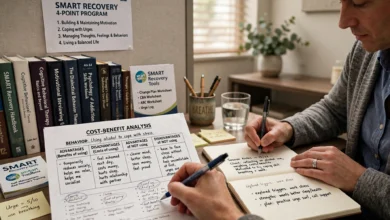
Every SMART Recovery meeting is organized loosely around the same four pillars:
- Building and maintaining motivation – identifying your reasons for change and keeping them front of mind when things get hard.
- Coping with urges – practical tools for riding out cravings without acting on them.
- Managing thoughts, feelings, and behaviors – cognitive techniques for catching and reframing the thinking patterns that drive addictive behavior.
- Living a balanced life – building a life with enough purpose and enjoyment that the addictive behavior loses its appeal.
You don’t move through these points in a straight line. Most people bounce between them depending on what’s happening in their life that week, and that’s considered completely normal, not a sign of failure. In fact, this is one of the most repeated reassurances you’ll hear at any SMART Recovery meeting: recovery is not a ladder you climb once and stay on. It’s closer to a set of tools you keep picking back up, sometimes in a different order than the last time.
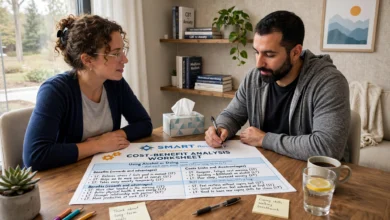
Each point of the program has its own dedicated set of worksheets and exercises that come up repeatedly across SMART Recovery meetings. For example, Point 1 often involves a Cost-Benefit Analysis, where participants weigh the short-term benefits of continuing an addictive behavior against its longer-term costs, laid out side by side on paper. Point 2 introduces urge-surfing techniques and DISARM (Destructive Images and Self-talk Awareness and Refusal Method), which helps members recognize and talk back to the internal voice that pushes them toward relapse. Point 3 leans heavily on the ABC model borrowed from cognitive behavioral therapy, tracing how an Activating event leads to a Belief, which then produces a Consequence. Point 4 focuses on Vital Absorbing Creative Interests (VACIs) and general lifestyle balance, encouraging participants to rebuild a life full enough that the addictive behavior no longer fills a void.
Who Runs SMART Recovery Meetings
Every SMART Recovery meeting is led by a trained volunteer facilitator, not a therapist or medical professional. Facilitators complete a formal training program through SMART Recovery and are certified to guide discussions using the organization’s tools and principles. Some facilitators have personal experience with addiction; others don’t. Either way, their job isn’t to lecture or diagnose. It’s to keep the discussion productive, make sure everyone gets a chance to participate if they want to, and steer the group back to practical tools when conversation drifts into pure venting.
This matters because it sets a different tone than you might expect. SMART Recovery meetings aren’t therapy sessions, and facilitators won’t offer clinical advice or diagnose anyone. They’re peer-support gatherings where the facilitator is more like a guide than an authority figure, someone who keeps the conversation moving and makes sure the group’s shared tools stay at the center of the discussion.
Facilitators complete SMART Recovery’s own training curriculum, which covers the 4-Point Program in depth along with group facilitation skills like managing dominant talkers, drawing out quieter members, and de-escalating tension if a discussion gets heated. Many facilitators also attend ongoing refresher trainings and regional conferences, and larger SMART Recovery meetings sometimes rotate between two or three trained facilitators so the group isn’t dependent on a single person’s schedule. If you ever attend a meeting and the regular facilitator is out, you can expect a co-facilitator or a trained substitute to run things using the same format, so the experience should feel consistent from week to week.
What Actually Happens During a SMART Recovery Meeting
Here’s the part most people really want to know. What does the hour actually look like?
1. The Opening
Most SMART Recovery meetings open with a short scripted or semi-scripted introduction from the facilitator. This usually covers what SMART stands for, a quick reminder of the meeting guidelines, a note that the meeting is anonymous and non-judgmental, and an invitation for anyone attending for the first time to introduce themselves if they’re comfortable doing so. Many facilitators will also briefly explain that SMART Recovery meetings are not affiliated with any 12-step organization, just so newcomers who’ve been to AA or NA before understand the format will feel different. If you’d rather stay quiet during this part, that’s fine. Nobody is going to put you on the spot, and the opening is designed to feel more like a orientation than a performance.
2. Check-In
Next comes the check-in, where each participant briefly shares how their week has gone. This is typically short, a couple of sentences, not a full life story. People might mention a craving they resisted, a stressful situation that tested them, or simply that things have been steady. Some SMART Recovery meetings ask members to rate their urge to use on a simple 1-to-10 scale during check-in, which gives the facilitator a quick sense of who might need extra attention that session. First-timers are welcome to pass or keep it as brief as they like, and it’s common for someone brand new to simply say their name and that they’re new, nothing more.
3. Choosing a Focus
After check-ins, the group, often guided by the facilitator, decides what to focus on for the rest of the session. Sometimes this is based on whatever theme keeps coming up during check-in, like several people mentioning stress at work or trouble sleeping. Other times the facilitator introduces a specific tool from the 4-Point Program, such as a cost-benefit analysis, a technique for disputing irrational beliefs, or a discussion of the ABC model. Because every SMART Recovery meeting is shaped partly by whoever shows up that day, no two sessions look exactly alike, even within the same weekly group.
4. Group Discussion and Tools
This is the heart of the meeting. Participants talk through real situations using SMART’s cognitive behavioral tools. You might see:
- Worksheets that walk through a specific thinking pattern or urge, often filled out together on a shared screen during online SMART Recovery meetings
- Role-playing exercises to practice handling triggering situations, such as rehearsing how to decline a drink at a family gathering
- Open discussion where members offer each other perspective, not advice framed as commands, since SMART discourages cross-talk that sounds like “you should” statements
- Group brainstorming on urge-coping strategies, where members pool ideas that have worked for them personally
The tone tends to be practical and forward-looking rather than focused on rehashing the past. SMART Recovery meetings spend relatively little time dissecting how someone got here and much more time figuring out what to do next. That forward focus is one of the more noticeable differences from programs built around personal inventories or step work, and it’s a big part of why some people describe SMART as feeling lighter or more solution-oriented.
5. Closing
Meetings typically wrap up with a brief closing statement from the facilitator, sometimes a reminder of upcoming SMART Recovery meetings or resources in the area, and an open invitation to stay after and chat informally if people want to. Some groups end with a short round where members state one thing they’re taking away from that day’s discussion, which reinforces whatever tool was introduced earlier in the session.
Most SMART Recovery meetings run 60 to 90 minutes, which lines up with what most support groups aim for. Online SMART Recovery meetings sometimes run slightly shorter, closer to an hour, since screen fatigue is a real factor facilitators try to account for.
What You Won’t Be Asked to Do
A lot of the anxiety around a first meeting comes from not knowing the unwritten rules. Here’s what SMART Recovery meetings specifically do not require:
- No forced sharing. You can attend and say nothing beyond your first name if that’s what you need.
- No “higher power” language. SMART is explicitly secular, so there’s no expectation to acknowledge a spiritual power greater than yourself.
- No labels. You won’t be asked to introduce yourself as “an addict” or “an alcoholic.” SMART deliberately avoids that framing.
- No sponsors or step work. There’s no sponsor system and no requirement to complete numbered steps in sequence.
- No judgment about relapse. If you’ve slipped, come anyway. Meetings are built around the understanding that recovery isn’t linear.
This lower-pressure structure is a big part of why people who felt uncomfortable with 12-step meetings often find SMART Recovery meetings a better fit. It’s worth repeating that none of this makes SMART “easier” than other programs. The work of changing an addictive behavior is still real work. What’s different is the framing: SMART Recovery meetings simply remove several layers of ritual and language that some people find genuinely uncomfortable, so more energy is left for the actual behavior change.
It’s also worth knowing what SMART Recovery meetings do ask of you, since low-pressure doesn’t mean no structure. You’ll generally be asked to:
- Respect confidentiality. What’s shared in the meeting stays in the meeting.
- Avoid cross-talk that sounds like commands. Offering your own experience is welcome; telling someone else exactly what they should do is discouraged.
- Stay roughly on topic. Facilitators will gently redirect if a discussion turns into venting without any connection to a tool or strategy.
- Show basic respect for other members, even when opinions or recovery philosophies differ.
None of this is unusual for a support group, but knowing it in advance means there are no surprises once you’re actually sitting in a SMART Recovery meeting.
In-Person vs. Online SMART Recovery Meetings
SMART Recovery meetings are available in both formats, and the core structure stays largely the same either way. A few practical differences are worth knowing about.
In-Person Meetings
- Held in community centers, churches, treatment facilities, libraries, and similar spaces
- Tend to run on a fixed weekly schedule at the same location
- Offer face-to-face connection, which some people find grounding
- May involve a sign-in sheet, though attendance is anonymous by design; you’re never required to give your last name
Online Meetings
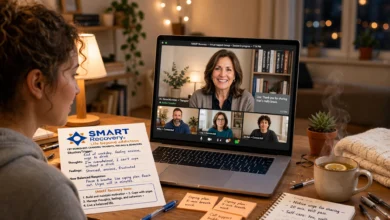
- Held via video platforms, with dozens of options running throughout the week
- Useful if you’re in a rural area, have mobility or scheduling limitations, or simply feel safer starting from home
- Cameras are usually optional, and many people attend their first few sessions with video off
- Chat features sometimes allow quieter participation without speaking aloud
Whichever format you pick, you can typically find a meeting finder tool on the official SMART Recovery website to filter by day, time, topic, and whether it’s a general meeting or a specialty group (family and friends, teens, veterans, and so on). Because SMART Recovery meetings run on a shared curriculum, someone who’s used to an in-person Tuesday night group can drop into an online Thursday session in a different time zone and still recognize the format immediately.
The Tools You’ll Actually Use in SMART Recovery Meetings
One of the biggest differences between SMART Recovery meetings and other support groups is how tool-driven the discussion is. Rather than open-ended sharing, most sessions circle back to a specific, nameable technique. Here are a few you’re likely to encounter early on:
- Cost-Benefit Analysis (CBA): A worksheet exercise where you list the short-term and long-term benefits and costs of continuing versus stopping an addictive behavior. It sounds simple, but seeing it laid out on paper during a SMART Recovery meeting often shifts how people talk about their own motivation.
- DISARM: A technique for recognizing “the addictive voice,” the internal urge that rationalizes one more drink, one more bet, or one more hit, and giving it a name so it’s easier to recognize and dismiss.
- The ABC Model: Borrowed directly from cognitive behavioral therapy, this maps how an Activating event leads to a Belief, which then produces a Consequence, helping members see that the belief, not just the event, drives the reaction.
- Hierarchy of Values (HOV): An exercise for clarifying what actually matters to you, used to reconnect daily choices with longer-term goals discussed in SMART Recovery meetings.
- Change Plan Worksheet: A structured way to set a concrete, specific goal and identify the steps and obstacles involved in reaching it.
Facilitators rotate through these tools depending on what the group needs that week, and most SMART Recovery meetings make copies of the relevant worksheet available, whether that’s a printed handout in person or a shared link in an online session.
SMART Recovery vs. 12-Step Programs
Since people often land on SMART Recovery meetings after researching AA or NA, it’s worth laying out the practical differences side by side.
| Feature | SMART Recovery | 12-Step (AA/NA) |
|---|---|---|
| Framework | Cognitive behavioral, self-management | Spiritual, higher power |
| Language | Secular, no labels required | “Addict” or “alcoholic” identification common |
| Structure | 4-Point Program, tools-based | 12 steps, sponsor system |
| Facilitator | Trained volunteer | Rotating member, sponsor-based |
| View of addiction | Learned behavior, changeable | Chronic disease |
| Meeting focus | Present and future, practical tools | Personal inventory, amends, surrender |
Neither approach is objectively “better.” Plenty of people combine both, attending SMART Recovery meetings alongside a 12-step group, or use SMART Recovery as their sole support system. What matters more is which framework actually resonates with how you think about your own recovery.
Who SMART Recovery Meetings Are For
SMART Recovery meetings are open to anyone struggling with an addictive behavior, and also to family members and friends who are supporting someone through it. Specialty meetings exist for:
- Family & Friends – built around the CRAFT approach for people affected by a loved one’s addictive behavior
- Teens and young adults – tailored language and pacing
- Military, veterans, and first responders – meetings addressing the specific pressures of those roles
- General recovery – open to any addictive behavior, from substances to gambling, gaming, or internet use
You don’t need a formal diagnosis or a referral to attend, and there’s no cost. SMART Recovery meetings are free, and you can attend as many or as few as you like, at whichever locations or times fit your schedule.
Cost and Accessibility
Because SMART Recovery meetings are run by a nonprofit and staffed entirely by volunteer facilitators, there’s no membership fee, no sliding scale, and no insurance requirement. The organization does accept donations, and some in-person locations pass a basket during the meeting the way many community groups do, but contributing is always optional and never tracked. This makes SMART Recovery meetings one of the more accessible recovery resources available, especially for people who don’t have insurance coverage for formal treatment or who are looking for something to supplement therapy rather than replace it.
Accessibility also extends to language and format. Some regions offer SMART Recovery meetings in languages other than English, and the organization has continued expanding online offerings specifically to reach people in areas without a nearby in-person option.
How to Prepare for Your First Meeting
If you’re still feeling nervous, a little preparation goes a long way:
- Pick a low-stakes meeting to start. An online meeting with your camera off is often the easiest first step.
- Arrive (or log in) a few minutes early. This gives you a moment to settle in without walking into a room mid-discussion.
- Decide ahead of time how much you want to share. It’s completely fine to say, “I’m just here to listen today.”
- Bring a notebook. Many people find it useful to jot down tools or phrases that stand out during the discussion.
- Try a few different meetings before deciding. Facilitator style and group dynamics vary, and it’s worth finding a group that feels like a good fit rather than judging the whole approach off one session.
Common Questions About SMART Recovery Meetings
Do I have to talk?
No. Passing during check-in or discussion is always an option, and no facilitator will pressure you to speak.
Is SMART Recovery religious?
No. It’s explicitly secular and doesn’t reference a higher power at any point in its program.
How much does it cost?
SMART Recovery meetings are free to attend. The organization is a nonprofit and relies on donations rather than membership fees.
Can I attend both SMART Recovery and 12-step meetings?
Yes. Many people use both simultaneously, and there’s no rule against combining approaches.
What if I relapse after starting SMART Recovery?
You’re still welcome. The program’s philosophy treats setbacks as part of the process, not a disqualifying event, and the group discussion at SMART Recovery meetings often revolves around exactly this kind of situation.
How often should I attend SMART Recovery meetings?
There’s no set requirement. Some people attend a single SMART Recovery meeting per week, others attend several across different days or online groups, especially early in recovery when extra support helps. Facilitators generally recommend trying a few meetings before settling into a routine that fits your schedule and needs.
Can I attend a SMART Recovery meeting if I’m not sure I have a problem?
Yes. Many people attend SMART Recovery meetings while still figuring out whether a behavior has become a genuine problem. You don’t need certainty or a diagnosis to sit in and listen.
Do SMART Recovery meetings work for behavioral addictions, not just substances?
Yes. SMART Recovery meetings are designed to apply to any addictive behavior, including gambling, gaming, shopping, and disordered eating, using the same 4-Point Program framework.
Is there a SMART Recovery app or online community outside of meetings?
Yes. Alongside live SMART Recovery meetings, the organization maintains 24/7 online message boards and chat rooms where members can connect between scheduled sessions.
Quick Recap: What to Expect at a SMART Recovery Meeting
If you only remember a handful of points before your first session, make it these:
- SMART Recovery meetings are free, secular, and open to anyone dealing with an addictive behavior.
- SMART Recovery meetings are led by trained volunteer facilitators, not therapists.
- A typical SMART Recovery meeting includes an opening, a check-in, a focus discussion, tool-based work, and a closing.
- SMART Recovery meetings run 60 to 90 minutes and are available both in person and online.
- Nobody at a SMART Recovery meeting will force you to share, label yourself, or discuss a higher power.
- SMART Recovery meetings use the 4-Point Program as their core structure, and tools like the ABC Model and Cost-Benefit Analysis show up regularly.
- You can attend as many SMART Recovery meetings as you like, at no cost, and combine them with other forms of treatment or support if that’s what works for you.
Final Thoughts
The best way to understand a SMART Recovery meeting is to sit in on one, but knowing the shape of it beforehand takes a lot of the guesswork out of that first step. You can expect a short opening, a low-pressure check-in, a practical discussion built around cognitive behavioral tools, and a facilitator whose job is to guide rather than direct.
There’s no higher power language, no forced labels, and no requirement to share more than you’re comfortable with. Whether you show up in person or log into an online session, the structure stays welcoming and grounded in the same 4-Point Program, and the only real requirement for attending is a willingness to show up and be part of the conversation.