The 4-Point Program of SMART Recovery Explained
SMART Recovery's 4-Point Program offers a science-based path to overcoming addiction through motivation, coping skills, and balance.
Anyone who has looked into addiction recovery options has probably run into two names again and again: 12-step programs and SMART Recovery. While both aim to help people break free from addictive behaviors, they take very different roads to get there. SMART Recovery, which stands for Self-Management and Recovery Training, is built on cognitive-behavioral principles rather than spiritual surrender or the idea of powerlessness. At the center of this approach sits the SMART Recovery 4-Point Program, a structured framework that gives people practical tools instead of abstract steps.
This program doesn’t ask participants to label themselves as addicts for life or to hand control over to a higher power. Instead, it treats recovery as a skill that can be learned, practiced, and improved over time. The four points work together as a system: building motivation, managing urges, handling difficult thoughts and emotions, and creating a life worth staying sober for.
In this article, we’ll break down each point of the SMART Recovery framework in detail, look at the science that supports it, compare it to traditional 12-step models, and walk through how someone might actually start using it. Whether you’re considering recovery for yourself or trying to understand it for a loved one, this guide covers what you need to know.
What Is SMART Recovery?
SMART Recovery is a global network of mutual-support meetings for people working through problems with addiction, whether that’s alcohol, drugs, gambling, or other compulsive behaviors. It was founded in 1994 as an alternative to Alcoholics Anonymous and other 12-step programs, drawing heavily on cognitive-behavioral therapy (CBT) and motivational interviewing.
Unlike programs that use a spiritual or disease-based model, SMART Recovery treats addiction as a learned behavior pattern that can be unlearned. Meetings are free, secular, and run by trained facilitators (many of whom are in recovery themselves). Participants aren’t required to identify as addicts or alcoholics, and there’s no expectation of lifelong meeting attendance. The program is meant to give people the tools to eventually manage their own recovery independently.
According to the National Institute on Drug Abuse, cognitive-behavioral approaches like the ones used in SMART Recovery have strong evidence behind them for treating substance use disorders, particularly because they teach skills that reduce relapse risk over the long term.
Understanding the SMART Recovery 4-Point Program
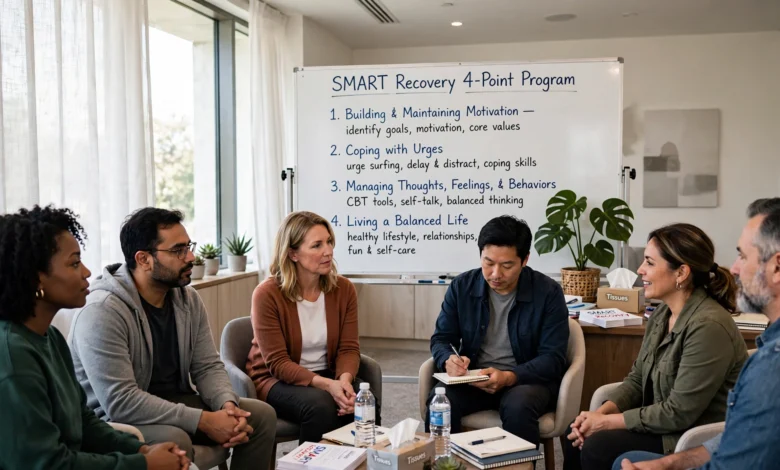
The 4-Point Program is the backbone of every SMART Recovery meeting and worksheet. It’s organized around four interconnected goals, and unlike the 12 steps, participants don’t have to move through them in strict order. People often work on more than one point at the same time, depending on where they are in their recovery.


Here’s a quick overview before we dig into each one:
- Building and maintaining motivation
- Coping with urges
- Managing thoughts, feelings, and behaviors
- Living a balanced life
Point 1: Building and Maintaining Motivation
Motivation isn’t something you either have or don’t have. In the SMART Recovery model, it’s treated as something you build and protect on purpose, because it naturally rises and falls. This first point of the program focuses on helping people get clear about why they want to change and keeping that reason visible, especially on hard days.
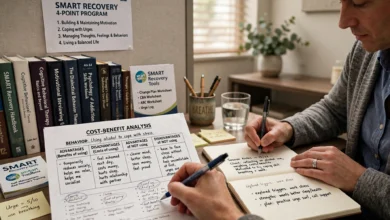
A common tool used here is the Cost-Benefit Analysis (CBA). Participants write out the short-term and long-term pros and cons of continuing a behavior versus changing it. This isn’t a one-time exercise. People are encouraged to revisit and update their CBA as their circumstances and priorities shift.
Some of the core techniques under this point include:
- Cost-Benefit Analysis worksheets to weigh the real trade-offs of substance use
- Identifying personal values and how addiction conflicts with them
- Setting specific, achievable goals rather than vague intentions
- Recognizing that motivation naturally fluctuates and planning for the low points
The idea is that motivation built on a person’s own values tends to hold up better than motivation borrowed from guilt, shame, or outside pressure.
Point 2: Coping with Urges
Urges and cravings are one of the biggest obstacles in early recovery, and this second point gives people concrete strategies to get through them without acting on them. SMART Recovery doesn’t pretend urges will disappear. Instead, it teaches that urges are temporary and manageable if you have a plan.
A widely used technique here is called DEADS (Delay, Escape, Avoid, Distract, Substitute). Participants learn to recognize an urge early, then apply one or more of these strategies to ride it out. Most cravings, research shows, peak and fade within 15 to 30 minutes if a person doesn’t act on them.
Other tools used to cope with urges include:
- Urge surfing, a mindfulness technique for observing a craving without reacting to it
- Identifying personal triggers, such as certain people, places, or emotional states
- Building a list of alternative activities to redirect energy during a craving
- Practicing the ABC model (Activating event, Belief, Consequence) to understand what sets off an urge
This point is often where people spend the most time early on, since urges tend to be strongest in the first weeks and months of change.
Point 3: Managing Thoughts, Feelings, and Behaviors
This is the point where SMART Recovery leans most heavily on cognitive-behavioral therapy. The premise is simple but powerful: how we think about a situation shapes how we feel about it, and how we feel shapes what we do. If someone can catch and reframe unhelpful thinking patterns, they can change the emotional and behavioral fallout that follows.
A central tool here is Albert Ellis’s ABC(DE) model, which stands for:
- A – Activating event (what happened)
- B – Belief (the thought or interpretation about what happened)
- C – Consequence (the emotion or behavior that results)
- D – Disputing (challenging the unhelpful belief)
- E – Effect (the new, more balanced outcome)
Participants also learn to spot common thinking traps, sometimes called “unhelpful thinking styles,” such as all-or-nothing thinking, catastrophizing, or blaming. By practicing rational self-analysis, people start to notice these patterns in real time instead of getting swept up in them.
This point also covers managing other mental health challenges that often show up alongside addiction, including anxiety, depression, and unresolved anger, since these frequently fuel relapse if left unaddressed.
Point 4: Living a Balanced Life
The final point shifts the focus from managing addiction to building a life that doesn’t revolve around it. This is often described as the “beyond addiction” phase, where the goal is lifestyle balance rather than crisis management.
SMART Recovery encourages participants to look honestly at how they spend their time and energy across different life areas, such as relationships, work, physical health, hobbies, and personal growth. The idea is that a life with variety and meaning leaves less room for old habits to creep back in.
Key elements of this point include:
- Identifying vital absorbing creative interests (VACIs), activities that genuinely engage a person’s attention and passion
- Setting goals across multiple life domains, not just sobriety
- Practicing gratitude and self-acceptance as ongoing habits
- Building healthy routines around sleep, exercise, and nutrition
- Repairing and strengthening relationships damaged during active addiction
This point is a reminder that recovery isn’t just about removing something harmful. It’s about replacing it with something meaningful.
How SMART Recovery Differs from 12-Step Programs
People often ask how the SMART Recovery 4-Point Program compares to Alcoholics Anonymous or Narcotics Anonymous. The differences are significant:
| Feature | SMART Recovery | 12-Step Programs |
|---|---|---|
| Foundation | Cognitive-behavioral science | Spiritual principles |
| Identity | No labels required | Often involves identifying as “addict” or “alcoholic” |
| Higher Power | Not part of the model | Central to the process |
| Structure | Four flexible points, worked in any order | 12 sequential steps |
| Sponsorship | Not required | Common practice |
| Meeting length | Typically time-limited with a facilitator | Varies by group |
Neither approach is universally “better.” Some people respond well to the community and spiritual framework of 12-step programs, while others prefer the more clinical, self-directed structure of SMART Recovery. It’s worth noting that these approaches aren’t mutually exclusive. Many people attend both types of meetings and take what works from each.
The Science Behind SMART Recovery
One of the reasons SMART Recovery has grown steadily since its founding is that its methods are grounded in research rather than tradition. Cognitive-behavioral therapy, motivational interviewing, and rational emotive behavior therapy have all been studied extensively and are recommended by major health organizations for treating substance use disorders.
The Substance Abuse and Mental Health Services Administration notes that evidence-based, skills-focused approaches tend to produce more consistent long-term outcomes than approaches that rely solely on peer support without a structured skill-building component. SMART Recovery’s four points give people a repeatable framework they can apply not just to substances, but to other compulsive behaviors like gambling, disordered eating, or internet addiction.
Tools and Techniques Used in Each Point
To make the program more concrete, here’s a summary of the main tools tied to each part of the framework:
- Motivation: Cost-Benefit Analysis, values clarification, goal-setting worksheets
- Urge Coping: DEADS technique, urge surfing, trigger identification, ABC model
- Thought Management: ABC(DE) model, rational self-analysis, disputing irrational beliefs
- Lifestyle Balance: VACI identification, gratitude practice, relationship repair, healthy routine building
Many of these tools are available as free worksheets through SMART Recovery’s official website, and facilitators typically walk participants through them during meetings.
Who Can Benefit from SMART Recovery?
The 4-Point Program was designed to be broad enough to help with a range of compulsive behaviors, not just substance use. People who might benefit include:
- Individuals seeking a secular alternative to 12-step programs
- People who prefer a skills-based, self-directed approach to recovery
- Those managing behavioral addictions such as gambling, shopping, or gaming
- Family members and friends looking to understand and support a loved one (through SMART Recovery Family & Friends)
- Anyone already in traditional treatment who wants an additional peer-support layer
It’s also worth mentioning that SMART Recovery works well alongside professional treatment, including therapy and medication-assisted treatment, rather than as a replacement for it.
How to Get Started with SMART Recovery
Getting started is fairly straightforward, and there’s no cost involved. Here’s a general path people follow:
- Find a meeting. SMART Recovery offers in-person meetings in many cities, plus online meetings available almost around the clock.
- Attend as an observer first, if needed. Newcomers aren’t required to share right away.
- Pick up the basic worksheets. Facilitators often introduce the Cost-Benefit Analysis and ABC model early on.
- Set a starting goal. This could be as simple as attending three meetings in the next two weeks.
- Keep showing up. Consistency matters more than intensity, especially in the first few months.
Because meetings are run by trained volunteer facilitators, the tone tends to be practical and conversational rather than confessional.
Tips for Success in the Program
A few things tend to separate people who stick with the SMART Recovery 4-Point Program long enough to see results from those who drop off early:
- Treat the worksheets as tools, not homework. Use them when a real situation calls for them.
- Don’t wait for motivation to feel constant. Revisit your Cost-Benefit Analysis when it dips.
- Combine meeting attendance with outside support, such as therapy, when possible.
- Give the fourth point (balanced living) real attention. Recovery that only removes something rarely lasts without something meaningful to replace it.
- Be patient. Cognitive habits take repetition to change, often more than people expect.
Conclusion
The SMART Recovery 4-Point Program offers a practical, science-backed alternative to traditional 12-step recovery, built around four connected goals: building motivation, coping with urges, managing thoughts and emotions, and creating a balanced life. Rather than asking participants to adopt a fixed identity or spiritual framework, it hands them a flexible toolkit they can adapt to their own situation and revisit as needed.
For anyone weighing their options, whether they’re new to recovery or looking for a different approach after trying something else, understanding how these four points work together is a solid starting point for building a plan that actually fits their life.