SMART Recovery Tools: 7 Essential Techniques for Lasting Sobriety
SMART Recovery tools offer a science-based path to sobriety. Explore the core techniques that help people build lasting, self-directed recovery.
SMART Recovery tools give people struggling with addiction a practical, science-based alternative to traditional 12-step programs. Instead of relying on spiritual surrender or the language of powerlessness, SMART Recovery is built on cognitive-behavioral principles and motivational psychology, giving participants concrete skills they can use the moment cravings or urges show up. The program’s full name, Self-Management and Recovery Training, says a lot about its philosophy: recovery isn’t something that happens to you, it’s something you actively build through practice and self-awareness.
If you’ve looked into recovery options before, you know the landscape can feel overwhelming. Some people thrive in traditional 12-step meetings, while others want an approach grounded more directly in behavioral science and less in spiritual framing. That’s where SMART Recovery fits in. It doesn’t ask participants to identify as an “addict” for life or hand control over to a higher power. Instead, it teaches specific tools for managing thoughts, emotions, and behaviors around substance use or other compulsive habits.
This handbook walks through the core tools of SMART Recovery, how the 4-Point Program works, and how to start using these techniques in daily life. Whether you’re new to recovery or looking for a method that fits better with how you think, understanding these tools can be the first step toward meaningful, lasting change.
What Is SMART Recovery?
SMART Recovery is a nonprofit, self-help program that uses cognitive-behavioral therapy (CBT) and motivational interviewing principles to help people overcome addictive behaviors, including alcohol use, drug use, gambling, and other compulsive habits. Meetings are free, peer-led, and available both in person and online, which makes them accessible to people in different stages of recovery and in different parts of the world.
Unlike abstinence-only frameworks that treat addiction as a lifelong disease requiring surrender, SMART Recovery treats addictive behavior as a learned habit that can be unlearned through structured effort. This distinction matters to many participants because it shifts the focus from identity (“I am an addict”) to behavior (“I engage in behaviors I want to change”). That shift alone can reduce shame and open the door to more honest self-examination.
The program is grounded in research from behavioral psychology, and it continues to update its materials as addiction science evolves. According to the National Institute on Alcohol Abuse and Alcoholism, evidence-based approaches like CBT are among the most effective tools for treating alcohol use disorder, which is part of why SMART Recovery has gained traction among clinicians and self-help communities alike.
The 4-Point Program: The Foundation of SMART Recovery Tools
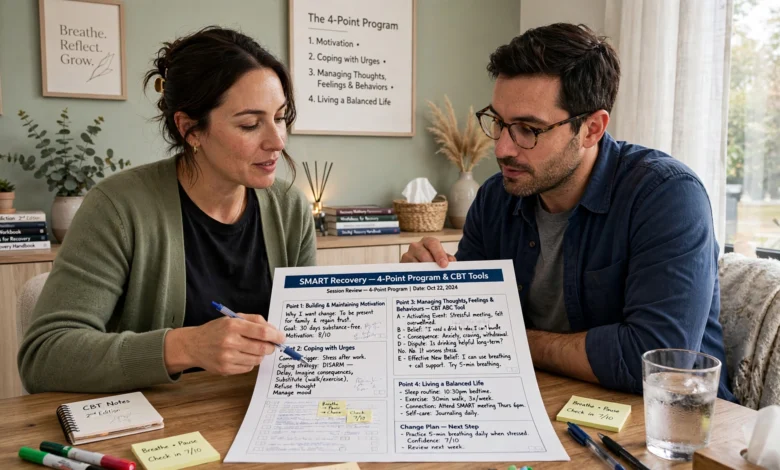
At the heart of SMART Recovery sits the 4-Point Program, a framework that organizes all the individual tools into four broad areas of focus.


1. Building and Maintaining Motivation
Motivation isn’t static. It rises and falls depending on mood, stress, and circumstances. This point of the program helps participants identify their personal reasons for change and keep those reasons visible, especially during moments of doubt. Tools here include cost-benefit analysis and values clarification exercises that reconnect people with what actually matters to them.
2. Coping with Urges
Cravings and urges are one of the most common relapse triggers. This part of the program teaches practical techniques for riding out an urge without acting on it, since most cravings peak and then fade within twenty to thirty minutes if left unfed.
3. Managing Thoughts, Feelings, and Behaviors
This point draws heavily from CBT. Participants learn to identify irrational or unhelpful beliefs that drive addictive behavior and replace them with more balanced thinking. The goal isn’t to suppress emotions but to respond to them in healthier ways.
4. Living a Balanced Life
Recovery isn’t just about stopping a behavior. It’s about building a life that doesn’t need that behavior to feel manageable. This point encourages participants to set goals, pursue hobbies, repair relationships, and create a lifestyle that supports long-term sobriety.
Essential SMART Recovery Tools You Should Know
Each point of the 4-Point Program is supported by specific, practical tools. Below are the ones most commonly used and taught in meetings.
Cost-Benefit Analysis (CBA)
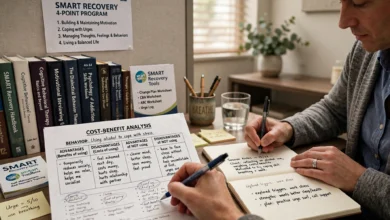
The Cost-Benefit Analysis is one of the most widely used SMART Recovery tools, and it’s often one of the first exercises new participants complete. It involves listing the perceived benefits and costs of continuing a behavior, then doing the same for changing it. Seeing these side by side, in writing, tends to make the imbalance obvious in a way that just thinking about it doesn’t.
A simple CBA might look like this:
- Benefits of drinking: temporary relief from stress, social ease
- Costs of drinking: damaged relationships, health problems, financial strain, guilt
- Benefits of quitting: better health, stronger relationships, financial stability
- Costs of quitting: discomfort in social settings, loss of a familiar coping habit
Writing this out helps people move past vague intentions and into a clear-eyed look at what they’re actually choosing between.
DISARM: Destructive Images and Self-talk Awareness and Refusal Method
DISARM is a tool for recognizing and countering the internal voice that pushes toward relapse. SMART Recovery often refers to this voice as the “addictive voice” or “Beast.” The tool works by helping participants notice manipulative self-talk (like “just one won’t hurt”) and respond with a firm, prepared counter-statement.
Over time, practicing DISARM builds a kind of mental muscle memory. The addictive voice doesn’t disappear overnight, but it does get quieter and easier to dismiss with consistent practice.
The ABC Model (Activating Event, Beliefs, Consequences)
Borrowed directly from Rational Emotive Behavior Therapy (REBT), the ABC model helps participants understand how their beliefs, not just external events, shape their emotional and behavioral responses.
- A (Activating Event): something happens, like a stressful phone call
- B (Belief): the thought that follows, such as “I can’t handle this without a drink”
- C (Consequence): the resulting emotion and behavior
By slowing down and examining the “B” step, people can catch irrational beliefs before they turn into automatic behavior. This is one of the more powerful SMART Recovery tools because it targets the thought pattern driving the behavior, not just the behavior itself.
Urge Surfing and the ABC’s of Urge Coping
Urge surfing teaches participants to observe a craving like a wave: it builds, peaks, and eventually recedes. Rather than fighting the urge or giving in immediately, the person learns to sit with the discomfort, breathe through it, and let it pass. Combined with distraction techniques and delay strategies, this tool gives people something concrete to do in the moment cravings hit hardest.
Hierarchy of Values
This exercise asks participants to rank what matters most to them, such as family, health, career, or personal integrity, and then examine whether their current behavior aligns with those values. When there’s a mismatch, it becomes a source of motivation for change that’s more durable than fear or external pressure alone.
Change Plan Worksheet
The Change Plan Worksheet functions like a roadmap. It asks participants to define specific goals, identify potential obstacles, and outline concrete steps for reaching those goals. This structured approach turns vague intentions like “I want to quit drinking” into an actionable plan with measurable steps.
Role-Playing and Rehearsal
Some situations, like turning down a drink at a party or setting a boundary with a using friend, are easier to navigate after they’ve been practiced. SMART Recovery meetings often include role-playing exercises so participants can rehearse difficult conversations and build confidence before facing them in real life.
How SMART Recovery Meetings Work
SMART Recovery meetings are peer-led and typically follow a loose structure, though they remain flexible depending on the group. A trained facilitator, who is often in recovery themselves, guides the discussion and introduces relevant tools based on what participants bring up.
Meetings generally include:
- A check-in, where participants share how their week has gone
- Discussion of specific challenges or successes
- Application of one or more SMART Recovery tools to a real situation
- Group feedback and support
Because the program isn’t based on a fixed number of steps, people can attend meetings for as long or as short a time as they find useful. Some attend for months, others for years, and some drop in occasionally for a refresher when they feel their motivation slipping.
SMART Recovery vs. 12-Step Programs
It’s worth understanding how SMART Recovery differs from more traditional approaches, since the right fit depends heavily on personal preference.
| Feature | SMART Recovery | 12-Step Programs |
|---|---|---|
| Framework | Cognitive-behavioral, self-management | Spiritual, higher power-based |
| Identity | Behavior-focused | Disease and identity-focused |
| Duration | Flexible, no fixed steps | Structured step progression |
| Sponsorship | No formal sponsor system | Sponsor-based support |
| Higher power | Not required | Central to the process |
Neither approach is objectively better. Some people benefit from combining both, attending SMART Recovery meetings for the practical tools while also participating in a 12-step group for the community and structure. The research generally supports flexibility here: what matters most is finding an approach that a person will actually stick with.
Using SMART Recovery Tools Outside of Meetings
You don’t have to wait for a meeting to put these tools into practice. Many participants keep a personal recovery journal where they:
- Complete a Cost-Benefit Analysis whenever motivation dips
- Track urges using the ABC model to spot patterns in triggers
- Write out DISARM responses in advance for predictable high-risk situations
- Revisit their Change Plan Worksheet monthly to track progress
The SMART Recovery organization also provides free downloadable worksheets and a mobile app, making it easier to apply these tools consistently rather than only during scheduled meetings. According to the SMART Recovery official site, these self-help resources are designed to be used independently, which gives people more flexibility than programs requiring consistent in-person attendance.
Tips for Getting the Most Out of SMART Recovery Tools
- Start small. Pick one tool, like the Cost-Benefit Analysis, and practice it consistently before adding others.
- Be honest in your worksheets. These tools only work if you’re truthful about your own thoughts and behaviors.
- Attend meetings regularly. Consistency helps reinforce the skills and keeps motivation from fading.
- Combine tools as needed. Urge surfing paired with DISARM, for example, often works better than either tool alone.
- Track progress over time. Recovery isn’t linear, and reviewing old worksheets can show growth that’s easy to miss day to day.
Frequently Asked Questions
Is SMART Recovery free? Yes, meetings are free to attend, and most worksheets and resources are available at no cost through the SMART Recovery website.
Can I use SMART Recovery alongside therapy or medication? Yes. SMART Recovery is designed to complement professional treatment, not replace it. Many participants use these tools alongside therapy, medication-assisted treatment, or outpatient programs.
Do I need to attend meetings to use the tools? No, though meetings provide accountability and peer support that many people find valuable. The tools themselves can be practiced independently.
Is SMART Recovery only for alcohol addiction? No. It’s used for a wide range of addictive behaviors, including drug use, gambling, food-related compulsions, and other habits people want to change.
Conclusion
SMART Recovery tools offer a structured, evidence-based path toward sobriety that doesn’t depend on spiritual language or lifelong identity labels. Through the 4-Point Program and techniques like the Cost-Benefit Analysis, DISARM, the ABC model, and the Change Plan Worksheet, participants gain practical skills they can apply the moment a craving hits or motivation wavers.
Whether used in meetings, independently, or alongside professional treatment, these tools give people a concrete way to understand their behavior and build a life that supports lasting change.