SMART Recovery: 7 Powerful Signs It’s the Right Path for You
Wondering if SMART Recovery fits your needs? This self-assessment guide breaks down what the program offers and how to know if it's for you.
SMART Recovery has become one of the most talked-about alternatives to traditional 12-step programs, and for good reason. If you’ve been researching recovery options, you’ve probably noticed that not every program fits every person. Some people thrive with a spiritual framework and the fellowship of AA or NA. Others want something grounded more in psychology and less in tradition. That’s where SMART Recovery tends to come up.
SMART stands for Self-Management and Recovery Training, and it’s built around cognitive behavioral techniques rather than the twelve steps or a higher power. It treats addiction as a learned behavior that can be unlearned through practical tools, not as a disease requiring lifelong surrender to a spiritual process. For some people, that distinction makes all the difference. For others, it might feel like it’s missing something they need.
This guide walks through what SMART Recovery actually involves, who tends to benefit most from it, and a set of honest self-assessment questions to help you figure out whether it’s the right fit for your recovery journey. There’s no universal answer here. Recovery is personal, and the “best” program is the one you’ll actually show up for and stick with. By the end of this article, you should have a clearer sense of whether SMART Recovery lines up with how you think, what you need from a support system, and where you are in your own process of change.
What Is SMART Recovery, Exactly?
SMART Recovery is a nonprofit, science-based recovery support program that uses cognitive behavioral therapy (CBT) and motivational interviewing techniques to help people manage addictive behaviors. It was founded in 1994 as an alternative to the 12-step model, and it now runs thousands of free meetings worldwide, both in person and online.
Unlike 12-step programs, SMART Recovery doesn’t use the language of “disease” or “powerlessness.” Instead, it frames addiction as a set of habits and thought patterns that can be identified, challenged, and changed. The program is built around what it calls the 4-Point Program:
- Building and maintaining motivation to change
- Coping with urges and cravings
- Managing thoughts, feelings, and behaviors in a balanced way
- Living a balanced life with healthy habits and goals
Meetings are facilitated (not “led” in a hierarchical sense) by trained volunteers, many of whom have their own recovery experience. Sessions tend to feel more like a discussion group or workshop than a religious service or confession circle. There’s no sponsor system, no steps to complete in order, and no requirement to identify as an “addict” or “alcoholic” for life.
This program also isn’t limited to substance use. SMART Recovery addresses a wide range of addictive behaviors, including gambling, disordered eating, compulsive shopping, and problematic internet or gaming use.

Why People Turn to SMART Recovery
There are a few common reasons people end up exploring SMART Recovery instead of, or alongside, traditional options:
- They want a secular approach without spiritual or religious language
- They’ve tried 12-step programs and didn’t connect with the format
- They prefer evidence-based tools they can apply immediately
- They want a structure that treats them as capable of change through their own effort
- They’re managing more than one addictive behavior and want one unified framework
None of this means SMART Recovery is “better” than other programs. It just approaches things from a different angle. According to the National Institute on Drug Abuse, mutual support groups of various formats, whether 12-step or cognitive-behavioral, can play a meaningful role in sustained recovery when they match a person’s needs and preferences. The fit matters as much as the framework itself.
Is SMART Recovery Right for You? A Self-Assessment
Here’s where things get practical. Below are honest questions to ask yourself. There’s no scoring system that spits out a verdict. Instead, treat this as a way to notice patterns in your own answers.
1. How Do You Feel About the Concept of “Powerlessness”?
Twelve-step programs are built around admitting powerlessness over addiction. If that phrase resonates with your experience, and you find comfort in surrendering control to something bigger than yourself, a 12-step model might suit you well.
If instead that language feels discouraging, or you’d rather focus on what you can control, SMART Recovery may feel like a better match. The program is built on the opposite premise: that you have the power to change your thoughts and behaviors through skill-building, not surrender.
2. Do You Prefer Structure Rooted in Psychology or Spirituality?
SMART Recovery leans heavily on cognitive behavioral therapy principles. If you’ve done CBT before, whether for anxiety, depression, or another issue, and found it useful, the tools in SMART Recovery will likely feel familiar and practical.
If you’re drawn to spiritual growth, prayer, meditation practices tied to a higher power, or a faith-based recovery community, a 12-step or faith-centered program might resonate more deeply.
3. Are You Comfortable With a Time-Limited or Flexible Commitment?
SMART Recovery doesn’t require lifelong meeting attendance or identifying as being “in recovery” forever. Many participants use the program intensively for a period, build their skill set, and then step back or attend less frequently once they feel equipped.
Ask yourself:
- Do you want a program you can eventually “graduate” from?
- Or do you want an ongoing community identity that continues indefinitely?
Neither answer is wrong. It’s simply a matter of what kind of long-term relationship you want with your recovery support.
4. Do You Want Tools You Can Use Outside of Meetings?
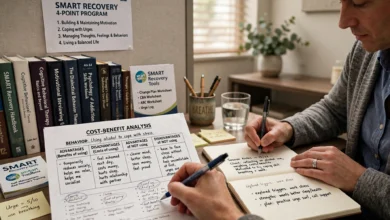
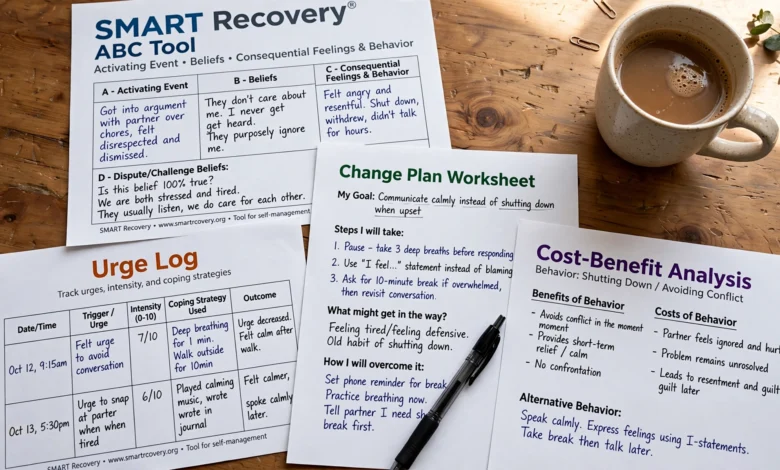
One hallmark of SMART Recovery is its emphasis on practical worksheets and exercises, including things like:
- The Cost-Benefit Analysis for evaluating a behavior’s pros and cons
- The ABC Model for examining Activating events, Beliefs, and Consequences
- DISARM techniques for countering addictive thinking patterns
- Urge-surfing and cost-benefit tools for cravings
If you like structured, worksheet-based tools you can apply between sessions, SMART Recovery’s approach will likely appeal to you. If you’re looking for something less structured and more focused on storytelling or shared experience, a different format might feel more natural.
5. How Do You Respond to Group Support?
Both SMART Recovery and 12-step programs rely on group meetings, but the tone differs. SMART Recovery meetings tend to be more interactive and discussion-based, with facilitators encouraging participants to challenge unhelpful thinking in real time. There’s less storytelling and more problem-solving.
Ask yourself:
- Do you want to actively work through specific challenges each week?
- Or do you want space to simply share your story and be heard?
Both are valid needs, and some people benefit from attending both types of meetings at different points in their recovery.
6. Are You Managing a Behavior Beyond Substance Use?
Because SMART Recovery addresses a broad range of addictive behaviors under one roof, it can be especially useful if you’re dealing with more than one issue, such as alcohol use alongside compulsive gambling, or food-related struggles alongside substance use. The tools apply across categories, since the underlying cognitive patterns tend to overlap.
7. Do You Have Access to Meetings That Fit Your Schedule?
Practical logistics matter more than people expect. SMART Recovery offers a large number of online meetings, which can be a real advantage if you live somewhere without an in-person option, or if your schedule doesn’t line up with local meeting times. Before committing to any program, check meeting availability in your area or your preferred online time slots.
Comparing SMART Recovery and 12-Step Programs
It can help to see the differences laid out directly.
| Feature | SMART Recovery | 12-Step Programs |
|---|---|---|
| Framework | Cognitive behavioral, science-based | Spiritual, step-based |
| View of addiction | Learned behavior, changeable | Chronic disease, powerlessness |
| Language | Secular | Often references a higher power |
| Duration | Often time-limited | Often lifelong |
| Sponsorship | None | Central to the model |
| Focus | Tools, self-management | Fellowship, surrender, steps |
Neither column is objectively superior. What matters is which framework matches how you personally process change and support.
Signs SMART Recovery Might Not Be the Best Fit
Fairness matters here, so it’s worth naming when this program might not be the right starting point:
- You’re in early crisis and need medical detox or intensive clinical treatment first. SMART Recovery is a support tool, not a substitute for medical care.
- You find comfort and motivation specifically through spiritual or faith-based frameworks, and secular language feels like it’s missing something you need.
- You strongly prefer one-on-one sponsorship relationships over group facilitation.
- You need trauma-focused therapy, which SMART Recovery meetings are not designed to provide directly, though many participants pair it with individual counseling.
If any of these describe you, it doesn’t mean SMART Recovery has nothing to offer. Many people combine approaches, using SMART Recovery tools alongside therapy, medication-assisted treatment, or even 12-step attendance. Recovery isn’t an exclusive membership.
How to Try SMART Recovery Before Committing
If your self-assessment leans toward SMART Recovery, there’s no reason to commit blindly. Here’s a low-pressure way to test it out:
- Attend one meeting, online or in person, without pressure to speak
- Review the toolkit on the official SMART Recovery website to see if the worksheets resonate with you
- Try one tool, such as the Cost-Benefit Analysis, on your own before your next meeting
- Compare your experience with any other program you’ve tried, noting specifically what felt different
- Give it a few sessions before deciding, since the format can take a meeting or two to feel natural
This kind of low-stakes trial run tends to give a clearer answer than reading about the program alone.
Combining SMART Recovery With Other Support
It’s worth repeating that this isn’t an either-or decision for most people. Many individuals in recovery use SMART Recovery as one part of a broader plan that might include:
- Individual therapy or counseling
- Medication-assisted treatment where appropriate
- Family or couples support
- Medical monitoring, especially in early recovery
- Occasional attendance at 12-step meetings as well
Recovery outcomes tend to improve when support is layered rather than limited to a single source. The Substance Abuse and Mental Health Services Administration notes that a combination of peer support, clinical treatment, and personal coping strategies generally produces stronger, more sustained results than any single approach used in isolation.
Final Self-Check Questions
Before wrapping up, run through this short checklist one more time:
- Do I respond better to psychological tools than spiritual language?
- Do I want a program I can eventually step back from?
- Am I comfortable with a more discussion-based, problem-solving meeting style?
- Do I have realistic access to meetings, in person or online?
- Am I managing more than one addictive behavior that a single framework could address?
- Am I open to combining this with therapy or other treatment if needed?
If most of your answers point toward yes, SMART Recovery is likely worth a genuine try. If your answers point elsewhere, that’s useful information too. It simply means your path might look different, and that’s completely fine.
Conclusion
Choosing a recovery program isn’t about finding the “correct” one; it’s about finding the one that actually fits how you think, what you need from support, and what kind of structure keeps you engaged over time. SMART Recovery offers a secular, tool-based, and flexible approach grounded in cognitive behavioral principles, which makes it a strong option for people who want practical skills and a sense of personal agency in their recovery.
It may not be the right fit for everyone, particularly those who need spiritual community, intensive clinical care, or one-on-one sponsorship. The self-assessment questions in this guide are meant to help you notice your own preferences honestly, so that whatever program you choose, in SMART Recovery or elsewhere, it’s one you’re actually likely to stick with.