How Mindfulness Therapy Reduces Anxiety and Depression
Mindfulness therapy calms the nervous system and rewires the brain. Learn how it eases anxiety and depression, backed by real research.
Mindfulness therapy has quietly become one of the most talked-about tools in mental health care, and for good reason. If you’ve spent any time lying awake replaying a conversation from three years ago, or felt your chest tighten before a meeting that hasn’t even started yet, you already know what anxiety and depression can do to a normal day. What’s less obvious is how something as simple as paying attention on purpose, without judgment, can actually change that pattern.
This isn’t wellness-influencer talk. Mindfulness-based interventions have been studied for decades, and the research keeps landing in the same place: people who practice mindfulness regularly report meaningfully lower anxiety and depression symptoms, and brain imaging studies back up why. Mindfulness doesn’t just distract you from stress. It changes how your brain processes threat, rumination, and emotional pain at a structural level.
In this article, we’ll walk through what mindfulness therapy actually is, the science behind why it works, the specific techniques therapists use, and how you can start building a practice of your own. Whether you’re dealing with generalized anxiety, low-grade depression, or just a mind that won’t slow down, understanding how mindfulness reduces anxiety and depression is the first step toward doing something about it.
What Is Mindfulness Therapy?
Mindfulness therapy is a therapeutic approach that trains you to notice your thoughts, feelings, and physical sensations as they happen, without immediately reacting to them or judging yourself for having them. It borrows heavily from centuries-old contemplative practices, but the clinical versions used today were adapted specifically for mental health treatment starting in the late 1970s.
The core skill being taught isn’t relaxation, even though relaxation is often a side effect. The real skill is present-moment awareness: the ability to step back from a thought like “I’m going to fail this presentation” and recognize it as just a thought, not a fact, not a prediction, and not something that needs to control your next hour.
Therapists who use mindfulness-based approaches typically combine:
- Guided meditation and breathing exercises
- Body scans to build awareness of physical tension
- Gentle movement, such as mindful walking or yoga
- Cognitive techniques borrowed from traditional talk therapy
- Group discussion and psychoeducation about stress and mood
This combination is what separates clinical mindfulness therapy from a basic meditation app. It’s structured, it’s taught by trained clinicians, and it’s designed around specific mental health outcomes rather than general stress relief.


How Anxiety and Depression Actually Affect the Mind and Body
Before we get into how mindfulness helps, it’s worth understanding what it’s working against.
Anxiety keeps the brain’s threat-detection system, centered in a structure called the amygdala, in a near-constant state of alert. Your body responds as if danger is present even when you’re just sitting at your desk, which is why anxiety often shows up as a racing heart, shallow breathing, or a tight stomach with no obvious cause.
Depression works differently but overlaps in damaging ways. It’s associated with reduced activity in areas of the brain tied to motivation and reward, along with a tendency toward rumination, replaying negative thoughts on a loop without resolving them. Depression also tends to shrink your world; you stop doing the things that used to bring you relief, which then deepens the low mood.
Both conditions share one dangerous mechanism: they pull your attention into the past or the future and keep it there. Anxiety lives in “what if.” Depression often lives in “what happened” or “what’s the point.” Neither leaves much room for what’s actually happening right now, which is exactly the space mindfulness therapy is designed to reclaim.
The Science: How Mindfulness Therapy Reduces Anxiety and Depression
This is the part that matters most, so let’s get specific about the mechanisms.
It Calms an Overactive Nervous System
Mindfulness practices, especially breath-focused ones, activate the parasympathetic nervous system, the “rest and digest” counterpart to the fight-or-flight response. Slower, deeper breathing signals to your brain that you’re not in danger, which lowers heart rate and reduces the physical symptoms of anxiety. Over time, regular practice appears to lower baseline cortisol, the primary stress hormone, so the body doesn’t stay flooded with it throughout the day.
It Reduces Rumination
Depression and anxiety both feed on repetitive negative thinking. Mindfulness training specifically targets this by teaching you to notice a thought forming, label it (“that’s a worry thought” or “that’s a self-critical thought”), and let it pass without following it down a spiral. Several studies have found that reductions in rumination are one of the strongest predictors of symptom improvement after mindfulness-based treatment.
It Changes Brain Structure and Activity
Neuroimaging research has found that consistent mindfulness practice is associated with:
- Reduced amygdala reactivity to stress and negative stimuli
- Increased gray matter density in the hippocampus, an area tied to learning and emotional regulation
- Strengthened connectivity between the prefrontal cortex (responsible for rational thinking) and the amygdala, which helps you respond to stress instead of reacting to it
This isn’t a one-time effect. Brain changes linked to mindfulness training tend to build with consistent practice, which is part of why an eight-week structured program is the standard in most clinical research.
It Improves Emotional Regulation
One of the most consistent findings across studies is that mindfulness improves your ability to sit with an uncomfortable emotion without needing to escape it, suppress it, or act on it impulsively. That skill, sometimes called “distress tolerance,” is directly tied to lower anxiety and fewer depressive relapses.
According to the <cite index=”4-1″>National Center for Complementary and Integrative Health, some research suggests that practicing meditation may reduce blood pressure, anxiety and depression, and insomnia</cite>. The same body of research notes that <cite index=”4-1″>a 2023 randomized controlled trial involving 208 participants found that mindfulness-based stress reduction was noninferior to escitalopram</cite>, a first-line medication for anxiety disorders. That’s a significant finding: a structured mindfulness program performed about as well as a commonly prescribed antidepressant for anxiety symptoms.
Types of Mindfulness Therapy Used in Clinical Settings
Not all mindfulness-based therapy looks the same. Here are the three most commonly used approaches.
Mindfulness-Based Stress Reduction (MBSR)
Developed by Jon Kabat-Zinn at the University of Massachusetts in 1979, MBSR is an eight-week group program combining meditation, body scans, and gentle yoga. It was originally designed for chronic pain patients but is now widely used for anxiety, depression, and general stress.
Mindfulness-Based Cognitive Therapy (MBCT)
MBCT combines mindfulness practices with traditional cognitive behavioral therapy techniques. It was specifically developed to prevent relapse in people with recurrent depression by helping them recognize the early warning signs of a depressive episode before it fully takes hold.
Acceptance and Commitment Therapy (ACT)
ACT uses mindfulness principles to help people accept difficult thoughts and feelings rather than fight them, while committing to actions aligned with their personal values. It’s especially useful for anxiety conditions where avoidance has become a coping pattern.
Each of these approaches shares the same foundation, present-moment, non-judgmental awareness, but applies it slightly differently depending on whether the goal is stress management, relapse prevention, or behavior change.
What the Research Actually Shows
It’s worth being honest here: not every study on mindfulness is high quality, and researchers themselves are the first to point this out. But the overall pattern across large reviews is consistent and encouraging.
A major analysis covering more than 12,000 participants found that <cite index=”5-1″>for treating anxiety and depression, mindfulness-based approaches were better than no treatment at all, and they worked as well as established evidence-based therapies</cite> such as cognitive behavioral therapy and medication. Separately, <cite index=”3-1″>a 2021 review of 23 studies with 1,815 adult participants diagnosed with anxiety disorders found that acceptance- and mindfulness-based interventions resulted in short-term reduction in anxiety</cite>, though the researchers noted more high-quality, long-term studies are still needed.
Safety data is reassuring too. A broad review of meditation research found that <cite index=”1-1″>about 8 percent of participants had a negative effect from practicing meditation, a rate similar to that reported for psychological therapies in general</cite>, meaning mindfulness carries roughly the same risk profile as other established forms of talk therapy, not a higher one.
You can read more of the underlying research directly from the National Center for Complementary and Integrative Health, which maintains an updated summary of clinical trials on meditation and mindfulness for anxiety and depression. The American Psychological Association also offers accessible guidance on how mindfulness fits into evidence-based mental health treatment.
Mindfulness Techniques You Can Practice Today
You don’t need a therapist to start experimenting with the basics. Here are techniques commonly taught in clinical mindfulness therapy programs:
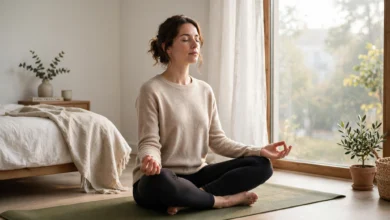
- Breath awareness – Sit quietly and focus only on the sensation of air moving in and out. When your mind wanders, gently bring it back, without scolding yourself for wandering in the first place.
- Body scan meditation – Slowly bring attention to each part of your body, from your feet to your head, noticing tension without trying to force it away.
- Five senses grounding – Name five things you can see, four you can touch, three you can hear, two you can smell, and one you can taste. This pulls attention out of anxious thought loops and back into the present.
- Mindful walking – Walk slowly and pay attention to the physical sensation of each step, the ground beneath your feet, and your surroundings.
- Thought labeling – When a worry or self-critical thought appears, silently label it (“planning,” “worrying,” “judging”) instead of engaging with its content.
- Loving-kindness meditation – Silently direct goodwill toward yourself and others, which has been shown to reduce self-criticism, a common driver of depressive symptoms.
How to Start a Mindfulness Practice for Anxiety and Depression
If you’re new to this, structure helps more than motivation does. Here’s a realistic way to begin.
- Start small. Five minutes a day is a legitimate starting point. Consistency matters far more than duration, especially in the first few weeks.
- Pick one anchor technique. Breath awareness is the easiest entry point for most people.
- Practice at the same time daily. Attaching mindfulness to an existing habit, like right after brushing your teeth, makes it far more likely to stick.
- Expect your mind to wander. This isn’t failure. Noticing the wandering and returning your attention is the actual exercise.
- Track how you feel, briefly. A short note before and after each session helps you notice patterns over weeks, not just individual sessions.
- Consider a structured program. If anxiety or depression is significantly affecting your life, an eight-week MBSR or MBCT course, ideally with a trained instructor, tends to produce more reliable results than self-directed practice alone.
Mindfulness Therapy vs. Traditional Treatment
A common question is whether mindfulness should replace medication or conventional talk therapy. For most people, the honest answer is that it works best alongside these treatments, not instead of them.
- For mild to moderate anxiety or depression, mindfulness-based programs can be effective as a standalone treatment for some people.
- For moderate to severe depression, or for anxiety disorders with significant functional impairment, mindfulness is generally most effective when combined with therapy, medication, or both.
- For relapse prevention, particularly with recurrent depression, MBCT has strong evidence specifically because it targets the thought patterns that tend to trigger a new episode.
This isn’t an either-or decision, and it’s not one you need to make alone. A mental health professional can help determine where mindfulness fits into your specific treatment plan.
Who Benefits Most From Mindfulness Therapy
Mindfulness-based approaches tend to help most when:
- Anxiety or low mood is tied to overthinking, worry spirals, or self-criticism
- You’ve had success with therapy before but want a daily maintenance tool
- You’ve experienced depression more than once and want to reduce relapse risk
- Stress shows up physically, through tension, poor sleep, or a racing heart
It tends to be less effective as a sole treatment for severe depression, active suicidal ideation, psychosis, or unprocessed trauma, situations where working directly with a licensed mental health professional is essential before or alongside any mindfulness practice.
Common Mistakes People Make When Starting Out
- Expecting an empty mind. Mindfulness isn’t about stopping thoughts; it’s about changing your relationship to them.
- Quitting after a few bad sessions. Some sessions will feel restless or uncomfortable. That’s normal and doesn’t mean the practice isn’t working.
- Using it only in crisis moments. Mindfulness is most protective when practiced regularly, not just pulled out during a panic spike.
- Skipping professional support when symptoms are severe. Self-guided mindfulness is a helpful tool, not a replacement for clinical care when symptoms are significant.
Conclusion
Mindfulness therapy reduces anxiety and depression by targeting the mechanisms that keep both conditions running: an overactive stress response, repetitive negative thinking, and a brain that’s stuck bracing for the past or the future instead of living in the present. Backed by decades of clinical research and supported by major reviews from institutions like the NCCIH, structured programs such as MBSR and MBCT have shown real, measurable benefits, sometimes rivaling standard treatments like medication, especially when practiced consistently.
It isn’t a cure-all, and it works best as part of a broader treatment plan for moderate to severe symptoms, but for the racing mind, the rumination, and the low-grade dread that anxiety and depression bring, mindfulness offers something rare: a practical, evidence-backed way to come back to the present moment, one breath at a time.